ColorBox is out!
Back in April 2023, I started working on an application that I thought would solve a few problems I had with my own workflow. I didn't quite anticipate that I would still be developing it three and a half years later, or that it would become what ColorBox is today.
As a colorist and filmmaker, I've always been particularly interested in the quality of light. Over the years, I found myself buying measurement instruments, comparing lights from different manufacturers and spending evenings trying to make sense of their spectral distributions and the various metrics we tend to rely on when purchasing lighting equipment.
The more measurements I took, the more questions I had. I was often surprised by how differently two lights behaved, despite having almost identical specifications on paper.
Then there was the software. Having invested in some rather expensive scientific instruments, I found myself using applications that looked and felt like they hadn't been revisited in decades. Every instrument came with its own software, often with limited analytical capabilities, and getting measurements from different instruments into a single environment was unnecessarily complicated.
Being a software engineer myself, at some point I decided to do something about it.
How ColorBox came to be
ColorBox was initially built to satisfy me. There was no commercial plan behind it, and for quite some time, I was effectively its only customer.
If I wanted to investigate something and the functionality wasn't there, I would build it. Quite often, while testing a new feature, I would discover something else that I wanted to investigate, which would inevitably lead to another few days of development.
This went on for years.
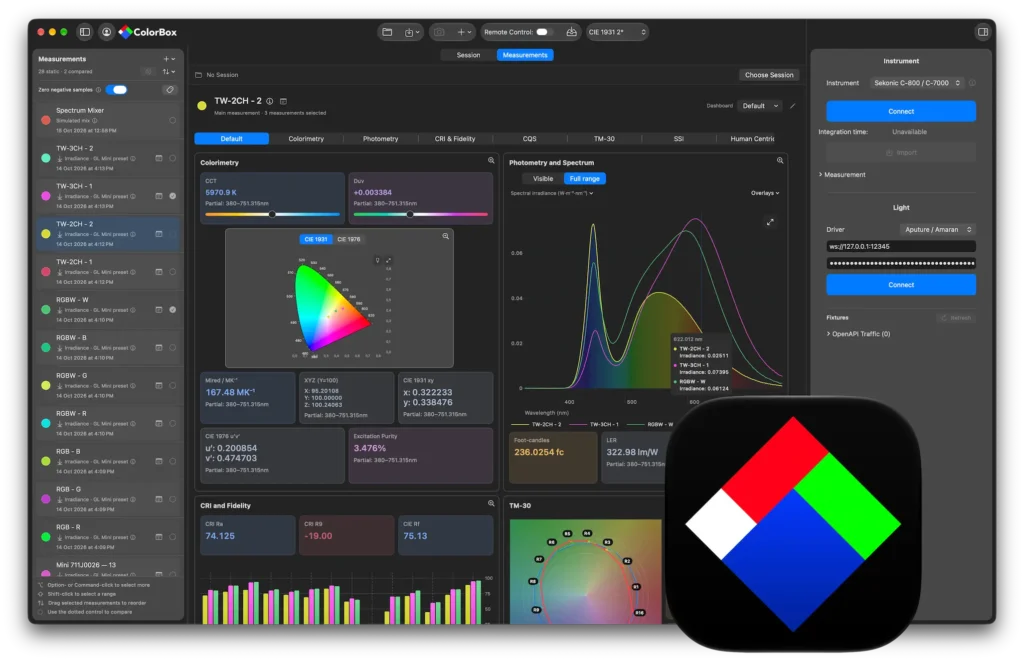
ColorBox today is a fairly extensive application covering display calibration, image analysis, color science and lighting analysis. There is a lot I want to talk about regarding the other parts of the application, but today we're focusing on the first part that is becoming commercially available: ColorBox Lighting Analysis.
Working with different measurement instruments
One thing I never particularly liked about existing measurement software is how closely it is tied to the hardware manufacturer.
I own instruments from several manufacturers, each of which I use for different reasons. I don't see why I should have to change my entire analytical workflow simply because I decided to use a different spectroradiometer.
A considerable amount of development time has gone into supporting instruments from different manufacturers, including Konica Minolta, JETI, Colorimetry Research, X-Rite and Barbieri, amongst others.
Having access to several of these instruments myself has also been invaluable during development.
Depending on the instrument and its configuration, ColorBox supports emissive and reflective measurements, spectral radiance, irradiance, reflectance and flicker analysis. Measurements from different instruments can coexist within the same project, be compared, analyzed and used to generate reports.
This is particularly useful when working with instruments that have different spectral resolutions, wavelength ranges or measurement geometries.
For those of us working in filmmaking
Something I have wanted to do for a long time is take a cinema light, connect it to my computer alongside a spectroradiometer and have the software characterize the light throughout its operating range.
Anyone who has reviewed lighting equipment will appreciate how tedious it can be to manually change the CCT, intensity and other parameters of a fixture, take a measurement, document the settings and repeat the process hundreds of times.
ColorBox can automate much of this.
With compatible lighting fixtures and control systems, the application can control the light itself, execute measurement sequences and collect the results automatically. For lights that cannot be controlled directly, there are guided manual measurement sequences.
You can also trigger measurements remotely from your iPhone or iPad, which is particularly convenient when working with larger lighting setups.
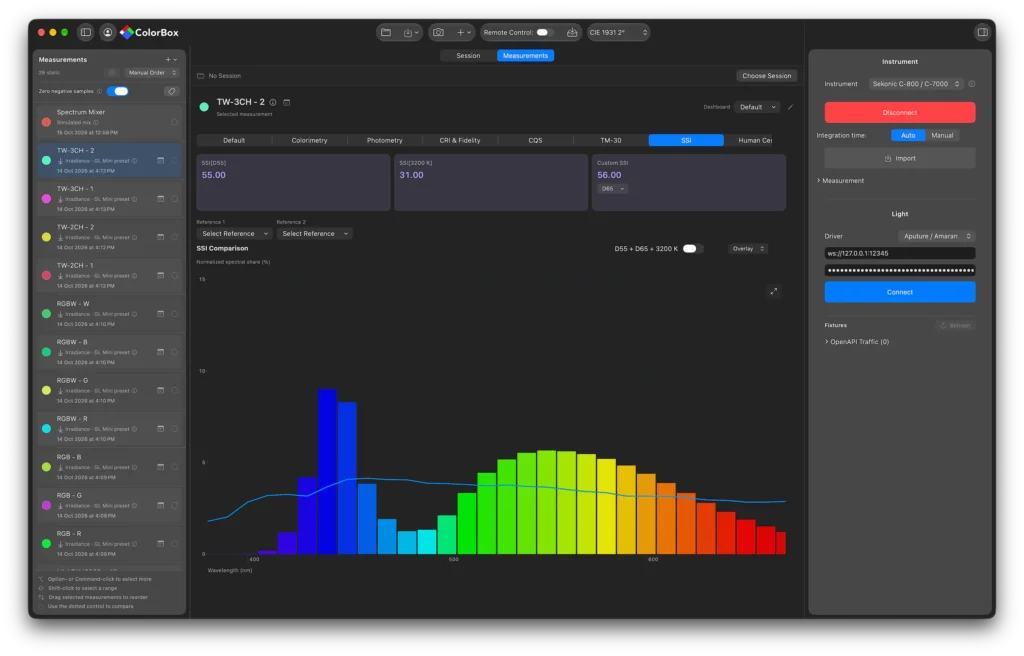
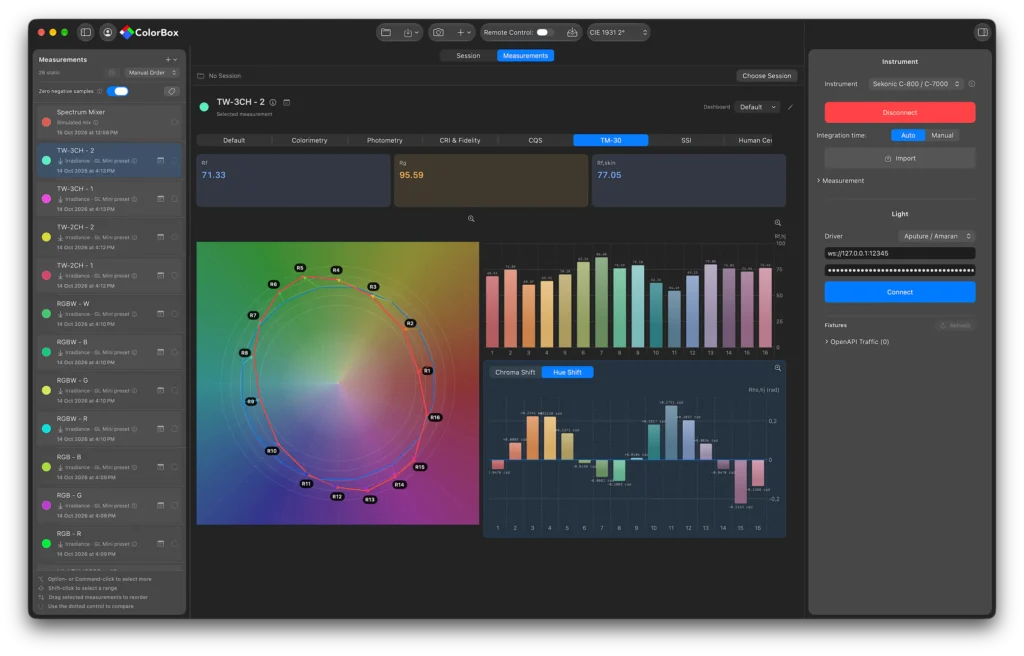
For filmmakers, gaffers and reviewers of cinema lighting equipment, there is extensive analysis around CRI, TM-30, SSI, TLCI, spectral distributions, color consistency, flicker and much more.
Personally, I find it far more interesting to look at the spectral characteristics of a light and understand why it behaves a certain way than simply establish whether it has a CRI of 95 or 97.
ColorBox gives you quite a few ways of doing that.
Some of the things I particularly enjoy using
Two features that I have spent a considerable amount of time developing are Spectral Mixer and Spectral Match.
Spectral Mixer came out of my curiosity about what would happen if I could manipulate a light's spectrum directly. What would happen to the color rendering if I increased the energy around a particular wavelength? Could I produce two spectra with the same CCT and chromaticity but substantially different melanopic responses?
You can literally draw a spectrum in ColorBox, introduce real measurements as individual light sources, mix them together and see how the resulting metrics change in real time.
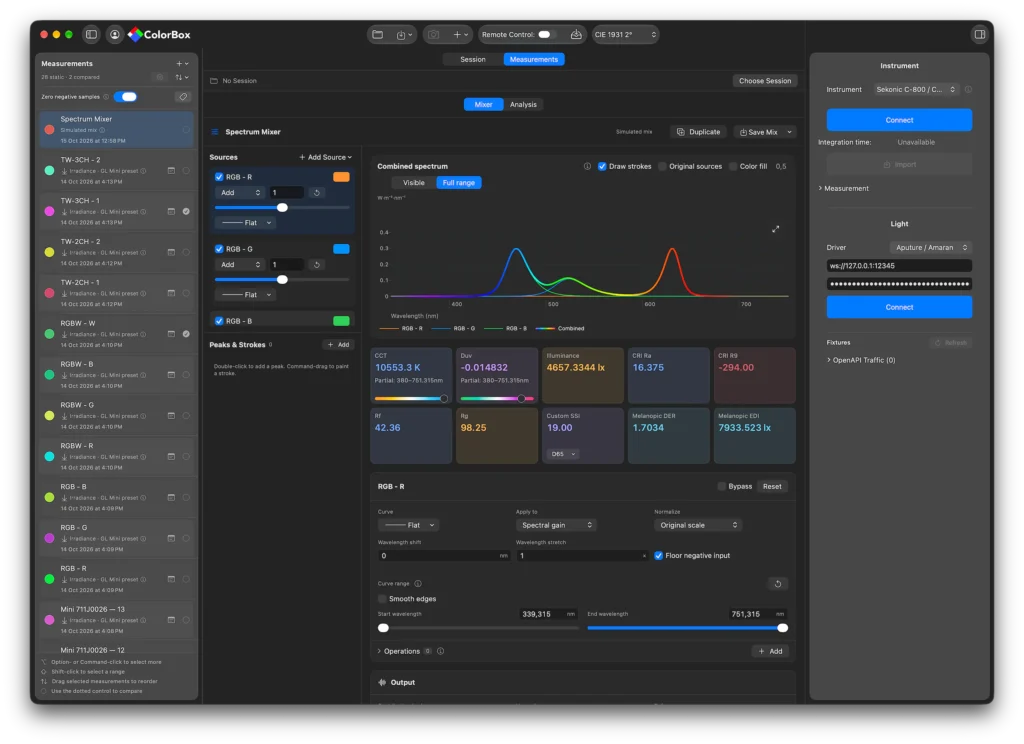
It's one of those tools that I occasionally open without having a particular task in mind and end up experimenting with for an hour.
Spectral Match approaches the problem from the other direction. If you have a particular spectrum that you want to reproduce, can you get close to it using commercially available LED components?
ColorBox includes a spectral library of hundreds of LED components from different manufacturers and can calculate combinations of these components to approximate a target spectrum.
Another feature that grew substantially during development is Dashboard Designer. As I started working with people from different disciplines, it became apparent that we were often looking at the same measurement but were interested in completely different things.
Rather than trying to accommodate everyone with predefined dashboards, I developed a system where you can build your own, arranging charts, metrics and analytical components around your particular workflow.
There are also continuous measurements, long-term stability studies, automated sequences, measurement tolerances, reference comparisons, extensive data exports and customizable PDF reports.
It goes quite a bit beyond cinema lighting
Although my interest in filmmaking was a significant part of what motivated me to develop ColorBox, some of the most interesting applications I've encountered have had absolutely nothing to do with filmmaking.
The relationship between light and our circadian rhythms, for example, has become a subject I find particularly fascinating. Two light sources producing the same illuminance and CCT can have considerably different melanopic equivalent daylight illuminance. Looking at their spectra makes it much easier to understand why.
ColorBox has gradually expanded to accommodate researchers, lighting designers, LED manufacturers, universities, laboratories and engineers working across different industries.
There are analytical tools for human-centric lighting, horticulture, poultry lighting, marine biology, museums and artwork conservation, amongst other applications.
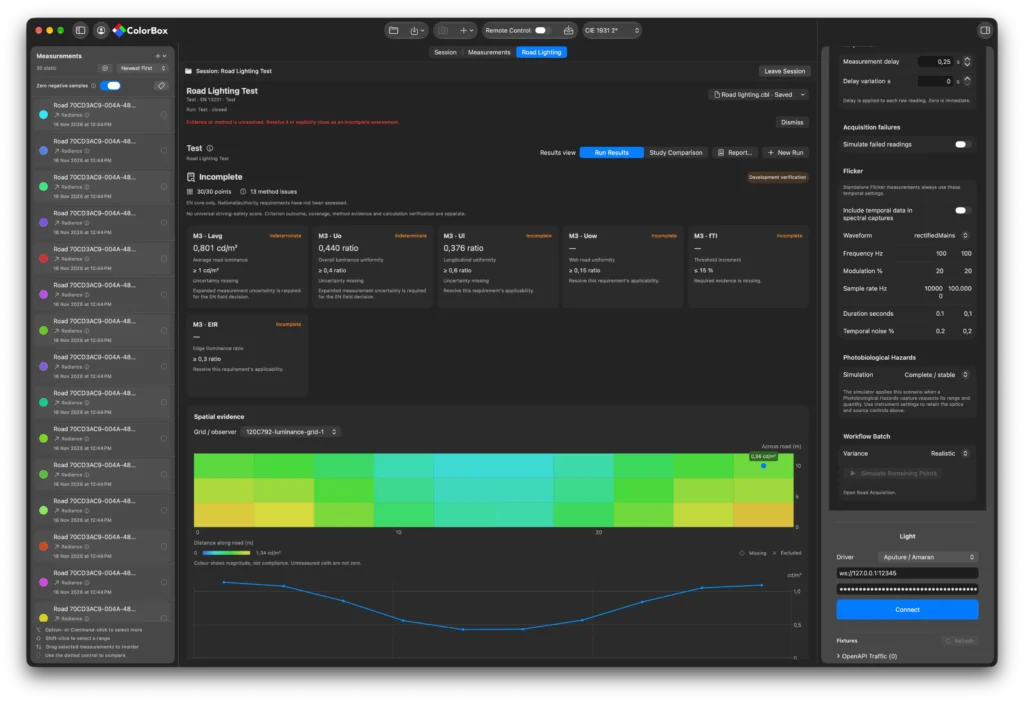
The software also incorporates metrics and methodologies from international CIE, IEC and EN standards, including dedicated workflows for photobiological safety and road lighting assessments.
Reflectance analysis opens up another set of applications entirely, particularly for people working with materials, printing and color management.
I certainly didn't envisage all of this when I wrote the first lines of code in April 2023.
A word about the application itself
ColorBox is a native macOS application, developed from the ground up.
Coming from a background where I spend a significant amount of time in creative software, I wanted to bring some of that experience into a scientific application.
I care about how a graph looks, how quickly I can interact with it, how measurements are organized and how easily I can get the information I need. I also care about being able to export a beautifully presented graph for a publication or a video without spending another half an hour recreating it elsewhere.
These may seem like relatively small things compared to the science involved, but when you spend hours every day using an application, they make a considerable difference.
Getting ColorBox
ColorBox Lighting Analysis is available from today in Standard and Professional editions, with both annual and perpetual licensing options.
Pricing starts at €249 per year for Standard and €799 per year for Professional. Perpetual licenses are also available at €590 and €1,990 respectively.
There is a fully functional seven-day trial of the Professional edition available for anyone who wants to explore the application with their own instruments and measurements.
You can find more information here:
- ColorBox – Features and capabilities
- ColorBox – Professional and scientific applications
- Pricing and free trial
And finally...
It's a slightly strange feeling making an application publicly available after having worked on it for so long.
For three and a half years, ColorBox has been part of my daily life. There have been plenty of occasions when I went into the studio to shoot a video and ended up writing software instead, simply because something about the light I was measuring caught my attention.
There are still many things I want to develop, instruments I want to support and areas of lighting science I want to explore.
What I'm particularly looking forward to now is having people use ColorBox for things I haven't thought of myself. I suspect some of the most interesting ideas for the application's future will come from people working in disciplines very different from my own.
If you work with light, or share some of my curiosity about it, do get in touch. Whether it's feedback, suggestions, instrument support or an interesting research project, I'd be very happy to hear from you.
And to everyone who has helped with the development, shared their knowledge, provided measurements, tested the application and challenged my understanding of lighting science over the past few years, thank you.
ColorBox is finally out.
Bill